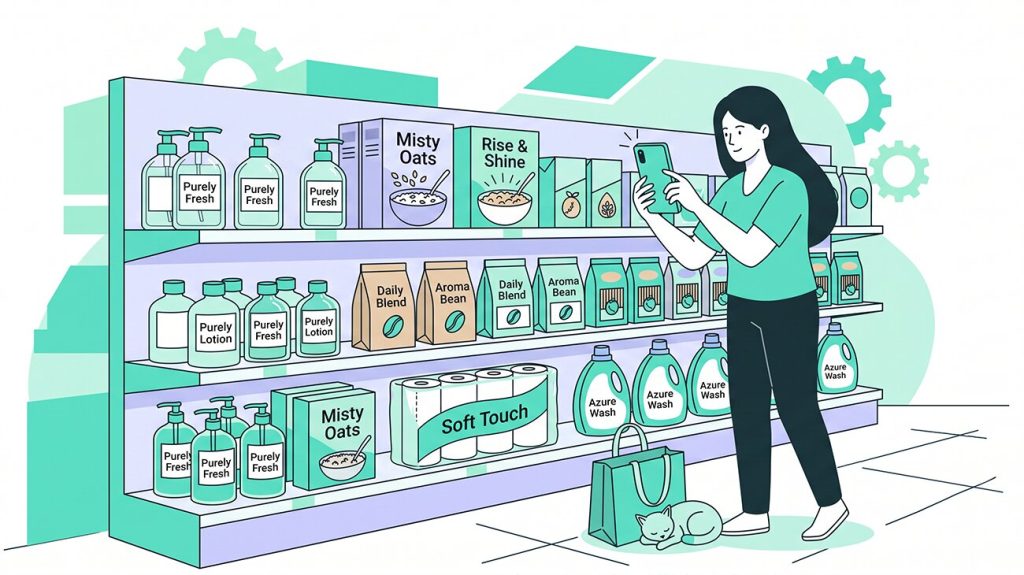


An FMCG manufacturer pays a team of a few dozen merchandisers year-round. The reports arrive on time, the team closes almost 100% of planned visits, sends several thousand shelf photos a week, and finds almost no violations.Category sales have stayed flat for two years, with no change in price, assortment, or the promo calendar.
Most heads of merchandising know this situation and stop finding it strange. The budget gets approved every year because the work is visible, and nobody can say what changed on the shelf over that year, because shelf condition was not measured before the field program started or after it.
The problem often starts with the task the company sets, not from the people in the field. A merchandiser gets an objective framed as basic shelf maintenance, without SKU priorities and without a target figure to improve, so they do what the company checks, and the company checks presence in the store.
Below are seven signs that a merchandising team is working in vain, based on what we see in FMCG manufacturers and merchandising agencies, with a fix after each one.
Table of Content:

- Attendance is not execution. Visit counts, photo volume, and coverage confirm that people came to the store, while on-shelf availability, share of shelf, planogram compliance, and promo execution are the only metrics that connect to the metrics that show what changed at the shelf and can be analyzed against commercial results.
- Many merchandising failures become visible at the shelf. The product is often already in the store while the facing stays empty, and a large share of promotional displays go up incorrectly or never go up at all, so weak results may come from execution, so shelf conditions should be checked before pricing or demand takes all the blame.
- Fix the brief before the team. Until the company defines a good shelf, measures it independently, and ties pay to that result, a new agency or a new set of merchandisers will produce the same outcome.
How to Tell If Your Merchandising Team Is Working Ineffectively

A merchandising team can look ineffective for reasons that have nothing to do with how hard people work. The company sets the wrong objective, writes standards nobody can check, measures the wrong things, or sees nothing in the store between visits. Each sign below shows what to avoid and what to fix in its place.
Sign 1: Field Visits Do Not Change Sales or KPIs
Nothing fails outright here, and that is why the first sign usually goes unnoticed for a long time. The stores your team covers grow at the same rate as the stores nobody visits, and no report contains that comparison.
The difference becomes obvious inside one chain. Two supermarkets of the same format carry the same assortment, the same price, and the same promo calendar, yet their category sales differ significantly. The category manager explains part of the gap through traffic and location and then has nothing else to offer, because nobody knows how many facings the brand holds in each store or whether the shelf was full on the day demand peaked.
There is also a milder version, where shelf KPIs exist but the company measures them once a quarter. By the time the quarterly report arrives, the data is already months old, so decisions get made on data that is already three months old.
What to change. Take one shelf metric and check how it changed over six months of field work. Without a starting figure, merchandising remains a cost line you cannot defend in a budget review. Which metrics change sales and which only create a feeling of control is the subject of our guide to merchandising KPIs.

Sign 2: Shelves Are Empty While the Product Is in the Store
You do not need analytics for the second sign. Walk your own stores, for example, on a Monday morning and count the gaps in the row.
Most of that missing product is already in the store. A widely cited ECR benchmark puts the average out-of-stock rate in European retail at about 8.6%, counting the share of listed items a shopper cannot find at the moment of purchase.
Your systems keep reporting full availability, because the stock is booked into the store. But the shopper sees an empty facing and takes a competitor product instead.
What to change. Measure on-shelf availability at the shelf and keep it separate from warehouse stock, because only one of these two figures matches what the shopper sees.

Sign 3: Promotions Fail Because the Shelf Is Not Ready
Marketing agrees the promo campaign with the retail chain, procurement ships the volume of goods, and media runs ads on schedule. Three weeks later the promo delivers half of the plan, and the review writes it off as weak consumer response.
Then someone visits the stores and sees the actual reason. POS materials stayed in the stockroom, a competitor occupied the promo zone in part of the network, and the promo SKU was missing from the shelf for much of the campaign period.
Market data confirms how common this is. A study by Shop! Association, formerly POPAI, found that around 60% of promotional displays are installed incorrectly or never installed at all. Manufacturers in the same study estimated their own promo compliance at about 70%, while the measured rate was closer to 40%. Harvard Business Review reports that more than 50% of promotions produce no measurable sales lift. A promo without shelf execution gives away margin and brings back no volume.
What to change. Confirm execution of the promo campaign in the first 48 hours across every store rather than on a sample, and approve the next stage of trade spend only after the setup is verified.

Sign 4: Customers Complain About Out-of-Stocks and Wrong Price Tags
A category manager at the chain writes that your product is missing from the shelf in dozens of stores while the stock is in the backroom. Your own system for the same week shows every visit closed, photo reports attached, and no violations logged. Two accounts of the same week contradict each other, and that contradiction is the signal.
Price tags produce the second group of complaints. The promo price on the shelf does not match the register, an expired tag remains after the campaign ends, and a newly listed SKU has no tag at all. The store gets a fine risk and an argument at the checkout, and the brand puts the retailer relationship at risk for no commercial reason.
What to change. Regular complaints from several chains point at the management of the field team rather than at individual employees. Record every complaint by store and date and compare it with your visit records, and within a month you will see which routes the system does not cover.

Sign 5: The Team Produces Photos and Reports Instead of Insights
Field teams send thousands of shelf photos a week, and nobody has the hours to review them. The process fails in a predictable way, and it starts with the supervisor.
One supervisor cannot revisit every store on their team’s routes, so they check what takes the least time, which comes down to the visit fact, the geotag, and a completed form. Display quality stays with the person whose work the report evaluates. Once the team understands which fields decide their score, they may complete those fields the way the score rewards. For example, one merchandiser photographs the tidy end of the aisle, another resubmits last week’s image, and a third fills in the checklist from memory in the car.
The company ends up with a data set nobody trusts. The photos do not form a metric, the metric has no link to sell-out, and managers make no decisions from the folder.
What to change. Any system where the person being measured also supplies the measurement creates a risk of biased or incomplete data. Add an independent source, such as sample audits or automatic recognition of shelf photos, so somebody outside the field team makes the assessment.

Sign 6: Planograms, Standards, and Promotions Look Different in Every Store
Visit several stores in the same chain and you will see one planogram executed in different ways. Facings differ, a competitor product splits the brand block, POS materials are not installed, and the seasonal zone exists in some locations and not in others.
Facings differ, a competitor product splits the brand block, POS materials are not installed, and the seasonal zone exists in some locations and not in others. The same inconsistency shows up in product rotation: older stock remains behind newer deliveries, expired products stay on the shelf, and FIFO rules exist in the standard but are not consistently followed.
That variation costs more than it looks. A fragmented brand block loses visual impact and makes the brand harder to recognize by the shopper, and a promo present in half the network delivers half the reach the campaign was priced for. The head office keeps planning against the standard while the stores keep working from the decision of whoever restocked the shelf last.
Companies in this position almost always have standards, usually a slide deck sent to the field. What they do not have is a compliance rate.
What to change. A standard is worth as much as what you measure against it. If you cannot produce a planogram compliance percentage for the previous seven days, you have a document, not an operational standard.

Sign 7: The Team Is Blamed for Problems the System Created
When results disappoint, commercial leadership questions field discipline and agency quality, and almost nobody examines the task the field team received.
Look at what the merchandiser was given. The objective is written as maintenance work, pay depends on visits completed, and shelf condition at the end of the visit affects nothing. Nobody defined a good shelf for the priority SKUs, and no tool shows a regional manager what happens across the territory.
What to change. Everything that separates merchandising from warehouse work sits outside that brief, including position in the category, integrity of the brand block, shelf level, and facings on key items. Until the company defines these things, the field team cannot deliver them. Correct the brief first, starting with objectives, then standards, then measurement, and only after that incentives.
The Real Root Causes: No Clear Objectives, KPIs, Standards or Technology

Read together, the seven signs describe one condition, and companies get into it for four reasons.
- KPIs that measure attendance. Visit counts, photo volume, and coverage confirm that people came to the store, while on-shelf availability, share of shelf, planogram compliance, price tag accuracy, and promo execution measure the shelf. Only the second group connects to revenue.
- No current data about the shelf. Companies that introduce structured measurement usually find real compliance much lower than assumed, and that difference stays invisible until somebody outside the field team measures it.
- Manual visits and self-reported forms. A supervisor covers a few stores a week, so nobody observes what happens in the rest of the network between visits.
- Technology applied to logistics instead of the shelf. Most companies digitized route planning and visit tracking, and supervisors still assess shelf condition by eye, although shelf condition is the part that changes sales.
What Strong Brands Do Instead

Companies that get a return on field work do four things differently, and none of them requires replacing people.
- Standards a person can execute and a system can score. Target facings on priority SKUs, position in the category, shelf level, and block integrity give the field team and the system the same definition of a good result.
- Objective shelf monitoring. Computer vision checks availability, share of shelf, planogram compliance, and promo execution across the network by one set of criteria, so the measurement no longer comes from the person being measured.
- Shelf data connected to sell-out and trade spend. Once a commercial director can analyze both data sets together, a promo budget gets defended or cut on the basis of what happened in the aisle.
- Reporting removed from the field team. The hours the team spent on forms return to filling gaps and rebuilding blocks, which is the part of a visit that changes the shelf.
How Computer Vision Changes Field Work

Very little changes in the daily routine of the merchandiser, who still photographs the shelf, except that the app now turns that photo into shelf metrics before the employee leaves the aisle.
For example, Goods Checker identifies products at SKU level with accuracy above 95% in client deployments and records gaps, misplaced items, missing price tags, and broken brand blocks while the employee is still in the store. Managers see results by store, category, brand, and employee, so a regional manager works with data that is minutes old.
Clients see the effect in operational numbers first. A merchandising agency covering 4,500 outlets cut audit time per store by half and reduced reporting time by 70%, to around 20 minutes from an hour. A gas station chain monitoring 200 SKUs across 500 remote locations raised planogram compliance from about 50% to 90%. Both kept the same field team, so the result came from what management could see and how quickly they could react.
The Problem Is Usually the System

Visits that do not change sales, empty shelves with stock in the building, promotions that fail in the aisle, complaints about availability and price tags, photo archives nobody reviews, standards executed differently in every store, and a field team blamed for problems it did not create. Seven signs, one management problem.
A commercial leader owes the field three things, a definition of a good shelf, a way to measure it, and a reason to reach it. Start with the metrics, because unclear KPIs make every other correction impossible to evaluate. Our breakdown of merchandising KPIs covers which ones work and which only measure attendance.
Then answer one question honestly. What do you know about the state of your shelves this week? If the answer comes from visit counts and photo volume, the problem is in the system and not in the people on the routes.
FAQ
What are the signs that a merchandising team is working in vain?
Visits that do not change sales, empty shelves while stock sits in the store, promotions that fail at execution, complaints from chains about availability and price tags, reports nobody uses, standards executed differently in every store, and a field team blamed for problems the system created.
How can I tell if my merchandising team is working ineffectively?
Compare covered stores with stores nobody visits over the same period. If the two grow at the same rate, the field work is not reaching the shelf. Then check whether you can name one shelf metric and say how it moved over the last six months.
Why are shelves empty when the product is in the store?
Stock is booked into the location, so the system reports full availability, while nobody moved the product from the backroom to the shelf. Store staff are stretched, the merchandiser has a full route, and refilling a gap loses to completing the checklist that a supervisor will review.
Which KPIs show that merchandisers are working in vain?
Any set built only from visit counts, photo volume, and coverage. Metrics that connect to revenue are on-shelf availability, share of shelf, planogram compliance, price tag accuracy, and promo execution.
Why do promotions fail when the budget was spent in full?
Because the shelf was not ready. POS materials stay in the stockroom, a competitor takes the promo zone, and the promo SKU is missing for part of the campaign. In the data this looks like weak consumer response, and the real cause is execution.
Should we replace the field team or change the agency?
Rarely. Check first whether the merchandiser has SKU priorities, a defined good shelf, and pay that depends on shelf condition. Without those, a new team produces the same result.
How does computer vision change the work?
The merchandiser still photographs the shelf, and the system turns that photo into shelf metrics while the employee is in the store. Managers see availability, share of shelf, planogram compliance, and price tag accuracy by store, brand, and employee instead of a folder of images nobody reviews.