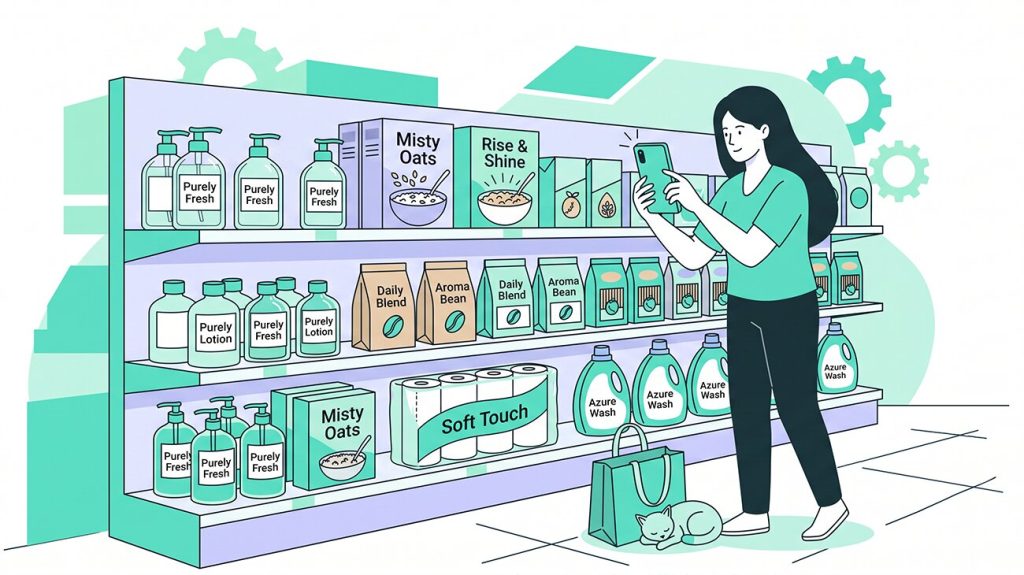


A brand can have the right product, the right price, and a national listing, and still lose sales at the shelf. The reason is usually mundane. The product sits two shelves below eye level, a competitor took the prime facing, the promo display went up a week late, or the shelf is simply empty. None of this shows up in a contract. It shows up in the store, where most companies have the least visibility.
This is the gap merchandising standards exist to close. They turn a vague goal like “we want strong shelf presence” into specific, checkable rules that a field team can follow and a manager can verify. Writing the standards is the easy part. The real challenge is making sure they actually happen in every store, every week, across a network that may run into the thousands of outlets.
In this article, we will look at what merchandising standards are, why they matter to manufacturers, distributors, and retailers, the core merchandising principles behind them, how companies build and enforce these standards, why on-shelf availability is one of the metrics that decides whether they work, and how digital tools now automate the control that used to rely on manual audits.
Table of Content:
- Key Takeaways
- What Are Merchandising Standards?
- Why Merchandising Standards Matter in Retail
- The 5 Core Principles of Merchandising
- Basic Merchandising Standards Every Retail Team Should Follow
- How Merchandising Standards Are Developed
- How Companies Implement Merchandising Standards Across Stores
- Common Merchandising Standards Mistakes
- Measuring Compliance with Merchandising Standards
- The Role of OSA (On-Shelf Availability)
- How Digital Merchandising Tools Improve Compliance and OSA
- How Goods Checker Helps Automate Merchandising Control
- The Standard Is Only as Good as Your Control Over It
- FAQ
Key Takeaways

Merchandising standards only raise sales when a company can check them often enough to catch problems while they still matter. The document itself changes nothing. The control over it does.
OSA is the metric most tightly linked to lost sales. A typical retailer loses about 4 percent of sales to empty shelves, and 70 to 90 percent of stockouts come from shelf and replenishment failures rather than supply shortages, which puts them squarely inside merchandising standards.
Manual audits cannot keep standards current at scale. In a network of a few stores a manual team keeps up, but across hundreds or thousands of outlets the audits fall behind the shelf, and digital shelf audit becomes a standard part of retail execution.
What Are Merchandising Standards?

Merchandising standards are the documented rules that define how a product should appear and perform at the point of sale. They cover what goes where, how much of it, at what price, and in what condition. A merchandiser, a store employee, or an automated system can check a shelf against these rules and say clearly whether the store is compliant or not.
The key word is documented. General merchandising advice (“keep best-sellers visible”) is a guideline. A standard is specific enough to audit. “The top three SKUs by velocity must hold a minimum of two facings each at eye level, with the current promotional price tag in place” is a standard. You can photograph that shelf and grade it.
Most merchandising standards in retail cover a consistent set of elements:
- Shelf placement. Which shelf and which position a product occupies, including height and proximity to category anchors.
- Facings. The number of product units visible at the front of the shelf, which controls how much visual space the brand holds.
- Planograms. The visual diagram that maps every product to an exact position on the shelf, used as the reference for compliance checks.
- Product visibility. Whether key SKUs are easy to find, unobstructed, and positioned where shoppers actually look.
- Pricing and promotional compliance. Whether the shelf price matches the agreed price and whether promotional displays, tags, and POSM are in place and correct.
Together these elements describe the difference between a shelf that follows a plan and a shelf that drifts. Without standards, every store interprets “good display” differently, and the brand loses control of how it shows up in front of the shopper.
Why Merchandising Standards Matter in Retail

Merchandising standards connect a commercial agreement to what a shopper actually sees. A listing fee buys the right to be on the shelf. Standards make sure that right turns into visibility, availability, and sales. The value looks different depending on where you sit in the chain.
Benefits for Manufacturers
For manufacturers, standards protect the investment they have already made. Trade marketing budgets, promotional spend, and slotting fees only pay off if the product is on the shelf, at the agreed position, at the agreed price. When standards slip, that spending leaks away quietly. The promo runs, demand arrives, and the shelf is half empty.
“Standards also give manufacturers a way to measure share of shelf against competitors. If the agreement calls for 30% of category facings and the real number is 18%, that is a problem worth several points of sales. Without a standard to check against, nobody notices until the quarterly numbers come in soft.”

Benefits for Distributors
Distributors run field teams across many accounts, and standards give those teams a single way of working. A merchandiser visiting a hypermarket and one visiting a convenience store follow the same rules, scaled to the format. That consistency makes the team easier to manage and the results easier to compare.
Standards also let distributors prove execution to the brands they represent. When a manufacturer asks whether their planogram is being followed in 400 stores, a distributor with clear standards and audit data can answer with evidence instead of assurances.
Benefits for Retailers
Retailers gain from standards because a well-merchandised store sells more and serves shoppers better. When categories are organized to a plan, shoppers find what they came for, discover related products, and leave satisfied. A messy or empty shelf does the opposite, sending the shopper to a competitor and sometimes keeping them there.
Standards also reduce out-of-stock situations at the category level. Clear facing rules and stock rotation requirements mean gaps get caught and filled faster, which protects category sales and the retailer’s relationship with its suppliers.
The 5 Core Principles of Merchandising
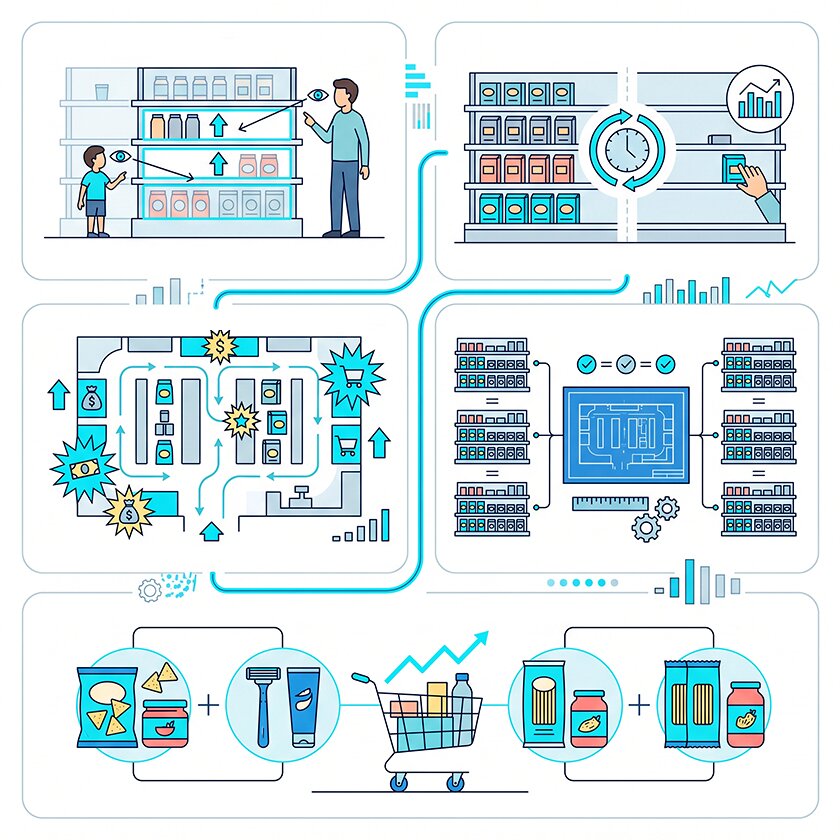
Behind the specific rules sit a handful of principles that explain why the rules work. These principles of retail merchandising apply whether you sell soft drinks, snacks, pharmaceuticals, or household goods. Understanding them helps a team apply standards intelligently rather than mechanically.
Product Visibility and Eye-Level Placement
The oldest principle in the trade is “eye-level is buy-level.” Products placed between roughly waist and eye height sell more than products on the top or bottom shelves, because that is where shoppers look first and reach most easily. The prime vertical zone is limited, which is exactly why it is fought over.
Eye level is not the same for every shopper. In a category aimed at children, such as cereal or confectionery, eye level sits lower, around the child’s line of sight. A standard that ignores who the shopper is will put the product in the wrong band. Good merchandising standards define the target zone by category and shopper rather than by a single fixed height.
Product Availability and On-Shelf Presence
A product that is not on the shelf cannot be bought, no matter how good its placement. On-shelf presence is the precondition for everything else. This is where many merchandising programs quietly fail, because availability changes hour to hour while audits happen once or twice a week.
The principle here is simple to state and hard to maintain. The right product must be physically present, in the right quantity, for as much of the selling day as possible. We return to this later under on-shelf availability, because it is the principle most directly tied to lost sales.
Strategic Product Placement
Shoppers move through a store along predictable paths, and some zones get far more traffic than others. The area near the entrance, the ends of aisles, and the route to high-demand staples are hot zones. Placing high-margin or impulse products in these zones lifts sales without changing anything about the product itself.
Strategic placement also means thinking about the shopper’s journey within the category. Anchoring a category with the products people are looking for, then placing complementary or higher-margin items along the natural reading path, guides the basket. A standard that maps placement to traffic and shopper flow captures sales that a random layout leaves on the table.
Consistency and Planogram Compliance
A standard only works if it is the same everywhere. Planogram compliance means every store in the network follows the same shelf plan, adjusted only for legitimate differences in space. When one store runs its own layout, the brand loses the ability to predict and compare performance, and category insights become noise.
Consistency is also what makes measurement possible. If every store follows the planogram, a drop in sales points to a real cause such as pricing, demand, or supply. If layouts vary store to store, you can never separate a merchandising problem from an execution problem. This is why planogram compliance sits at the center of any serious merchandising standard.
Cross-Merchandising and Category Synergy
Products sell better next to the things people use them with. Placing tortilla chips beside salsa, razors beside shaving gel, or pasta beside sauce prompts a second purchase the shopper had not planned. This is cross-merchandising, and it works because it matches how people actually shop, by occasion rather than by category.
An example: a beverage brand running a summer grilling promotion gains more from a secondary display next to disposable plates and charcoal than from extra facings in the drinks aisle alone. The standard that allows for these adjacencies, and defines them clearly, turns a single product into part of a basket.
Basic Merchandising Standards Every Retail Team Should Follow

Principles explain the why. Standards turn them into a checklist a field team can run in every store. The list below covers the basic merchandising standards that apply across most FMCG categories. Treat it as a baseline to adapt to your own categories.
- Correct facings. Each key SKU holds the agreed number of facings, with no competitor product creeping into the brand’s space.
- Accurate pricing. The shelf price matches the agreed price, and every price tag is present, current, and readable.
- Promotional execution. Promo displays, secondary placements, and offer tags are up on time, in the right location, with the correct mechanics.
- Shelf cleanliness. The shelf and products are clean, undamaged, and free of expired or out-of-date stock.
- Stock rotation. Older stock sits in front so it sells first, and near-expiry product is pulled before it reaches the shopper.
- Visibility of key SKUs. The top-selling and strategic SKUs sit in the defined visibility zone, unobstructed and easy to find.
- POSM placement. Point-of-sale materials such as shelf strips, wobblers, and display units are present and correctly placed.
A team that checks these seven items consistently catches most of the problems that erode shelf performance. The difficulty is doing it consistently, in every store, often enough to matter. That is the gap between having standards and meeting them.
How Merchandising Standards Are Developed

Good standards are built on data rather than opinion. A planogram that reflects how a category actually sells will outperform one drawn around assumptions about how it should sell. The development process moves from understanding the shopper and the category to defining objectives, building the plan, and refining it against real results.
Consumer and Category Analysis
The starting point is how shoppers behave in the category. Which products drive the trip, which are bought on impulse, how shoppers navigate the shelf, and what they tend to buy together. Sales data, loyalty data, and in-store observation all feed this picture. The aim is to understand demand before deciding where anything goes.
Defining Shelf Objectives
Once the category is understood, the team sets clear objectives for the shelf. These might be a target share of facings for the brand, a minimum visibility band for key SKUs, or a defined space for new products. Objectives have to be specific and measurable, because they become the standards the field team is later judged against.
Creating Planograms and Display Guidelines
With objectives set, the team builds the planogram that places every product on the shelf and writes the display guidelines that go with it. This is where principles become a concrete plan: facing counts, shelf positions, adjacencies, and promotional rules all get written down in a form a merchandiser can follow and an auditor can check.
Testing and Refining Standards
A planogram is a hypothesis until it meets a real store. Companies test new standards in a sample of outlets, measure the effect on sales and availability, and adjust before rolling out widely. Standards built this way improve over time, because each cycle of testing feeds back into the next plan. Standards frozen on day one slowly drift away from how the category actually performs.
How Companies Implement Merchandising Standards Across Stores

Writing a standard is the easy part. Getting it executed across hundreds or thousands of stores, week after week, is where most programs are won or lost. Implementation rests on five connected activities.
- Training. Field teams and store staff have to know the standard before they can meet it. Training covers the planogram, the facing rules, the pricing checks, and how to handle common exceptions. A standard nobody understands gets ignored at the shelf.
- Field teams. Merchandisers and sales reps carry the standard into the store. They set the shelf, fix what has drifted, place POSM, and record the state of each outlet. The size and routing of the field team determines how often each store is actually touched.
- Audits. Someone has to check whether the standard is being met. Audits compare the real shelf against the planogram and grade compliance. The value of an audit depends entirely on how current it is, which is the weak point of any manual approach.
- Reporting. Audit results have to reach the people who can act on them, broken down by store, region, brand, and SKU. Reporting turns scattered observations into a picture management can use to find where execution is failing.
- Continuous improvement. The cycle feeds back. Patterns in the reports show which stores, regions, or SKUs need attention, and the standard itself gets refined. A program that closes this loop keeps getting better. One that audits without acting just generates paperwork.
Common Merchandising Standards Mistakes

Even well-designed merchandising standards fail when execution breaks down. Most companies do not struggle because they lack standards. They struggle because the standards are too complex, applied inconsistently, or measured too infrequently. Several mistakes appear repeatedly across retail networks.
- Using the same standard for every store format. A hypermarket and a convenience store require different shelf strategies.
- Auditing too infrequently. The shelf changes daily, while audits often happen weekly.
- Treating compliance as a KPI rather than a process. Teams optimize for audit scores instead of execution quality.
- Ignoring OSA. Products exist in inventory but disappear from the shelf.
- Relying entirely on manual photo reviews. Managers spend more time reviewing photos than fixing problems.
Measuring Compliance with Merchandising Standards

Merchandising compliance is the measure of how closely real shelves match the defined standards. You cannot manage what you do not measure, and compliance measurement is where many companies discover that their standards exist mostly on paper. The traditional methods all work, but each runs into limits once the network grows past a few stores.
Store Audits
A merchandiser or auditor walks the store, checks the shelf against the planogram, and records what they find. This is the foundation of compliance measurement and the most direct way to see the shelf. The limit is frequency. A store audited twice a week is unmonitored for the other five days, and a lot can go wrong in five days.
Photo Reports
Many teams now capture shelf photos during each visit as evidence. Photos are richer than a checklist and harder to fudge. The problem appears on the receiving end: a supervisor handed hundreds of photos a day cannot review them all in time to act. The evidence exists, but the bottleneck moves to whoever has to look at it.
Compliance Scoring
To compare stores and track progress, companies convert audit findings into a compliance score, often a percentage against the standard. Scoring makes performance visible and comparable. Its accuracy depends on the consistency of the people doing the grading, and manual grading varies from one auditor to the next.
Performance Dashboards
Dashboards pull compliance data together so managers can see trends by store, region, and SKU. A good dashboard turns thousands of checks into a few clear signals. But a dashboard is only as fresh as the data feeding it, and when that data comes from manual audits processed by hand, the picture a manager sees can be several days behind the shelf.
Manual vs Automated Merchandising Control
| Aspect | Manual Control | Automated Control |
|---|---|---|
|
Shelf audits
|
Periodic
|
Continuous
|
|
OSA tracking
|
Sample-based
|
Real-time
|
|
Planogram compliance
|
Manual review
|
Automatic
|
|
Reporting speed
|
Days
|
Minutes
|
|
Scalability
|
Limited |
Network-wide |
|
Human error
|
High
|
Low
|
The common thread across all four methods is lag. Manual compliance measurement shows you the shelf as it was at the last visit, while the current shelf may already look different. For a metric that changes by the hour, that lag is the core weakness, and it is the reason availability problems slip through.
The Role of OSA (On-Shelf Availability)
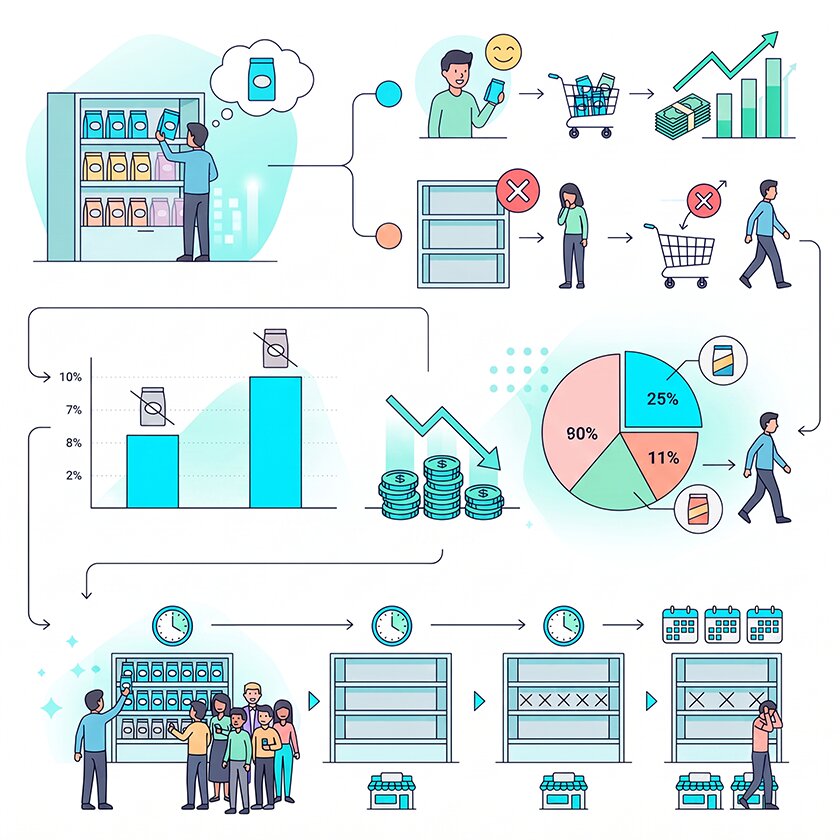
On-shelf availability, or OSA, measures whether the products shoppers want are actually present and findable on the shelf when they look. It is the most operational of all merchandising metrics, because it captures the moment of truth: a shopper reaches for a product and either finds it or does not.
OSA matters because an empty shelf is a sale lost outright, and often a customer lost with it. Industry studies put average out-of-stock rates for FMCG products at around 8%, rising toward 10% for fast sellers and promoted items. In the fast-moving consumer goods industry, stockouts average around 8% and jump to 10% for fast-sellers and brands on promotion, which means roughly one in thirteen products is missing from the shelf. The cost of that gap is large. Research findings show that a typical retailer loses about 4% of sales due to items being out of stock.
“The connection to merchandising standards is direct. Most availability problems start at the shelf rather than in the supply chain. Around 70 to 90 percent of stockouts are caused by defective shelf replenishment practices, rather than upstream supply shortages. A product can be sitting in the back room while the shelf in front of it is empty. Standards for stock rotation, facing maintenance, and replenishment exist precisely to prevent this, but they only help if someone catches the gap quickly.”
Consider a high-velocity SKU that sells out by mid-morning and stays empty until the next merchandiser visit two days later. Every shopper who wanted it in that window either bought a competitor or left without it. Multiply that across a few hundred stores and a few dozen SKUs, and the lost sales add up faster than any pricing or promotion lever can recover. This is why OSA, more than almost any other number, decides whether a merchandising standard delivers its promised sales.
How Digital Merchandising Tools Improve Compliance and OSA

The weakness of manual control is lag, and lag is exactly what digital tools remove. By collecting shelf data in the field and processing it automatically, these tools shrink the gap between what happens at the shelf and when a manager finds out. The result is compliance and OSA data that is current enough to act on.
Mobile Audits and Field Data Collection
Instead of paper forms and separate cameras, merchandisers work through a mobile app that captures photos, records stock, and structures the visit. Data goes to a central system the moment it is collected, instead of days later when someone types it up. The visit itself gets faster, and the record is consistent across the whole field team.
Image Recognition and Shelf Analytics
This is the part that changes the economics. Image recognition reads a shelf photo and identifies products at the SKU level, counts facings, checks positions against the planogram, and flags gaps and price errors automatically. The supervisor who used to review hundreds of photos by hand no longer has to. The system does the reading, and the people focus on the exceptions.
Real-Time Compliance Monitoring
Because the analysis is automatic, compliance can be monitored close to real time rather than reconstructed from a backlog. A manager sees which stores are out of compliance today, which SKUs are missing now, and where a promo failed to go up, while there is still time to fix it. The dashboard reflects the current shelf instead of last week’s.
AI-Powered Retail Execution
Pulling these pieces together, AI-powered retail execution treats the shelf as a continuous data source rather than a periodic snapshot. Field visits feed structured data, image recognition turns photos into metrics, and managers act on current information. The standard stops being a document that gets checked occasionally and becomes a target the whole operation can see and steer toward every day.
How Goods Checker Helps Automate Merchandising Control
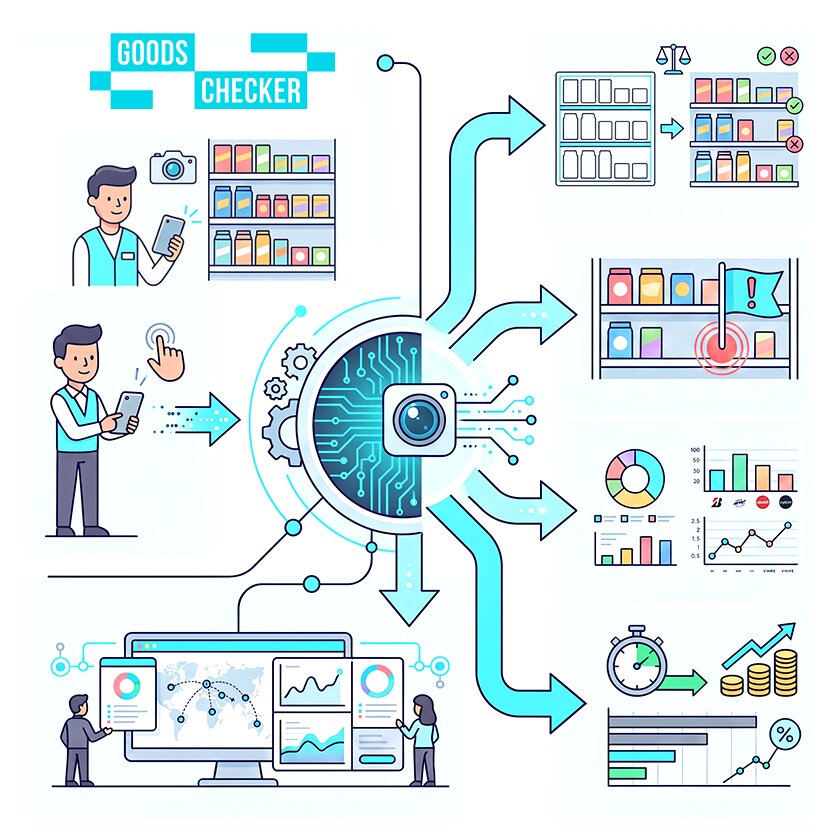
Goods Checker applies this approach to the everyday work of FMCG and retail teams. A merchandiser photographs the shelf in the mobile app, the system processes the image, and within seconds it returns what is on the shelf, how it compares to the planogram, and where the gaps are. The manual reading step that creates all the lag is removed.
The platform covers the same control points a merchandising standard defines. Photo recognition reads products at the SKU level. Planogram compliance monitoring compares the real shelf to the plan and scores it. OSA measurement flags missing products as they go missing. Shelf analytics report facings, share of shelf, and pricing by store, brand, and SKU, and retail execution visibility gives managers a current view across the whole network instead of a delayed sample.
The results show up as time and accuracy. A merchandising agency in Ukraine, Lex Marketing, used the platform across more than 4,500 outlets and cut reporting time by 70%, with SKU recognition accuracy above 95%. Merchandisers who once spent close to an hour a day on reporting now spend under 20 minutes, which frees them to cover more stores or run deeper checks. Because the system reads every photo the same way, the human variation that creeps into manual grading drops out of the data.
The scale point matters most for OSA. A pharmaceutical manufacturer used Goods Checker across 8,800 pharmacy outlets in Kazakhstan, Uzbekistan, and Kyrgyzstan, keeping visit times under five minutes while holding recognition accuracy above 90%. At that size, manual audits cannot keep the availability picture current. Automated reading can, which is what lets a standard hold up across thousands of stores rather than the dozens a manual team can realistically watch.
The Standard Is Only as Good as Your Control Over It

Merchandising standards are how a brand turns a shelf agreement into actual sales. The principles behind them, visibility, availability, smart placement, consistency, and category synergy, have not changed in decades, and the basic standards that follow from them are well understood. What has changed is the ability to control them.
A standard only raises sales when a company can check it often enough to catch problems while they still matter. In a network of a few stores, a manual team can do that. In a network of hundreds or thousands, manual audits fall behind the shelf, and the metric that suffers most is on-shelf availability, the one most tightly linked to lost sales. This is why digital shelf audit has moved from a nice-to-have to a standard part of retail execution. The companies that keep their standards current are the ones that turn them into the sales those standards were written to protect.
FAQ
What are merchandising standards?
Merchandising standards are documented rules that define how a product should appear and perform at the point of sale, covering shelf placement, facings, pricing, promotional execution, and product condition. They are specific enough to audit, which separates them from general display advice.
What are the 5 core principles of merchandising?
The five core principles are product visibility and eye-level placement, on-shelf availability, strategic product placement based on shopper traffic, consistency and planogram compliance, and cross-merchandising of complementary products.
What is OSA in retail?
OSA stands for on-shelf availability. It measures whether the products shoppers want are actually present and findable on the shelf when they look. Low OSA means lost sales, since a product that is not on the shelf cannot be bought.
Why is planogram compliance important?
Planogram compliance keeps every store in a network following the same shelf plan, which protects brand visibility and makes performance comparable across stores. Without it, a company cannot tell whether a sales problem comes from merchandising, pricing, or demand.
How do companies measure merchandising compliance?
Companies measure compliance through store audits, shelf photo reports, compliance scoring against the standard, and performance dashboards. Manual versions of these methods lag behind the real shelf, which is why many companies move to automated, image-based monitoring.
How does technology improve on-shelf availability?
Digital tools collect shelf data in the field and use image recognition to read products and flag gaps automatically, close to real time. Managers see missing SKUs while there is still time to restock, instead of finding out at the next manual audit days later.