Table of Сontents
-
- — Good afternoon. Let’s start at the beginning. What was IBA Ukraine’s main mission at launch, and has it changed since then?
- — What was the key trigger for creating Goods Checker? Was it a specific client request, or did you initially identify a gap in the merchandising market?
- — How exactly does Goods Checker work from the user’s perspective? What happens behind the scenes with computer vision and AI?
- — How long does integrating Goods Checker with retailer systems take?
- — Who are your main competitors in this sector?
- — Which retail formats is Goods Checker suited for? Does it work equally well in supermarkets, convenience stores, and hypermarkets?
- — What data and analytics does a client receive after a shelf audit? How can these insights be used for assortment or category management?
- — A client not yet familiar with Goods Checker will immediately ask: “How much does it cost?” What do you say?
- — What results have real Goods Checker implementations in Ukraine and abroad already shown? Can you share effectiveness examples with numbers?
- — In your opinion, how ready is the Ukrainian market for AI tools like this? How have the war and economic challenges affected demand?
- — How do you see these solutions evolving in retail over the next 3–5 years? Can computer vision become the standard for shelf management?

Sergey Baibara, director of IT company IBA Ukraine, shared with All Retail the details of the service launch and the results of its retail implementation.
— Good afternoon. Let’s start at the beginning. What was IBA Ukraine’s main mission at launch, and has it changed since then?
— IBA Ukraine has been operating in the market for over 13 years — since 2012 — and is part of the international IT company IBA Group, with headquarters in Prague and offices worldwide. During this time, we’ve implemented projects for companies across different industries. Among our clients in Ukraine are leading mobile operators and the Ukrainian Energy Exchange, and the country’s largest banks use our SoftPOS solution.
Our mission is helping businesses work more efficiently through IT, and Goods Checker is one of the products we’re developing for the Ukrainian and international markets.
— What was the key trigger for creating Goods Checker? Was it a specific client request, or did you initially identify a gap in the merchandising market?
— In 2019, an FMCG manufacturer approached us. Merchandisers were photographing shelves and sending images to managers, but managers could only review individual photos. As a result, they received reports that didn’t reflect the real picture. They needed to understand what was happening with products on shelves and whether planogram compliance was being maintained — quickly and across all stores simultaneously.
We started investigating and found that this problem was common across different clients. Manufacturers invest serious budgets in merchandising, but managers have no reliable way to verify how shelf standards are actually followed. The real shelf situation in stores often differs from what’s written in reports — products are positioned incorrectly or not displayed at all, required facing counts aren’t met, and so on. Because of this, it’s impossible to accurately assess merchandising effectiveness.
We had already worked with artificial intelligence in other projects and understood that computer vision was best suited for display control. This technology makes it possible to quickly and accurately analyze shelf photos and obtain precise data on merchandiser performance. That’s how Goods Checker emerged — a cloud service that helps manufacturers and merchandising agencies automatically enforce shelf standards and receive complete, current, and reliable analytics.
IBA Group is an alliance of IT companies located in Europe, North America, and Asia. IBA Group is one of the largest developers and providers of modern information technologies in Eastern Europe.
— How exactly does Goods Checker work from the user’s perspective? What happens behind the scenes with computer vision and AI?
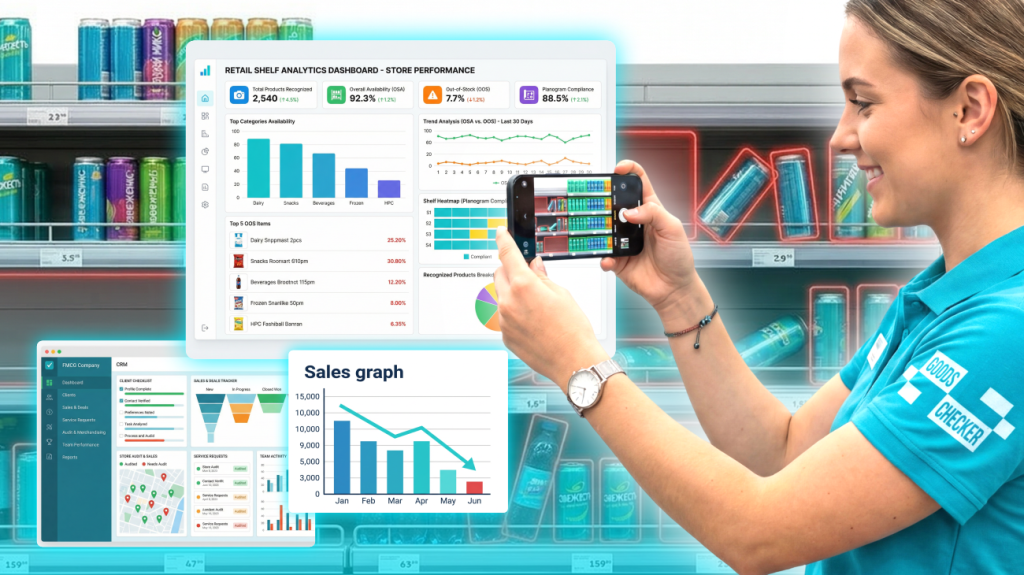
— From the user’s perspective, everything is simple. A merchandiser comes to a store, opens the app, and photographs the shelf. The image automatically uploads to the server, where it’s processed in seconds. The merchandiser immediately sees an annotated photo in the app and understands what needs to be fixed for the display to match the planogram. Processing results are also available to managers in web browsers or BI systems.
The foundation of this process is a set of neural networks that we train on the client’s SKUs. They recognize each product on the shelf, determine its position, count facings, detect empty spaces, and identify price tags and promotional materials.
Based on this data, the system automatically generates analytics — for example, planogram compliance percentage, shelf share by brand and SKU, competitor presence, and other KPIs.
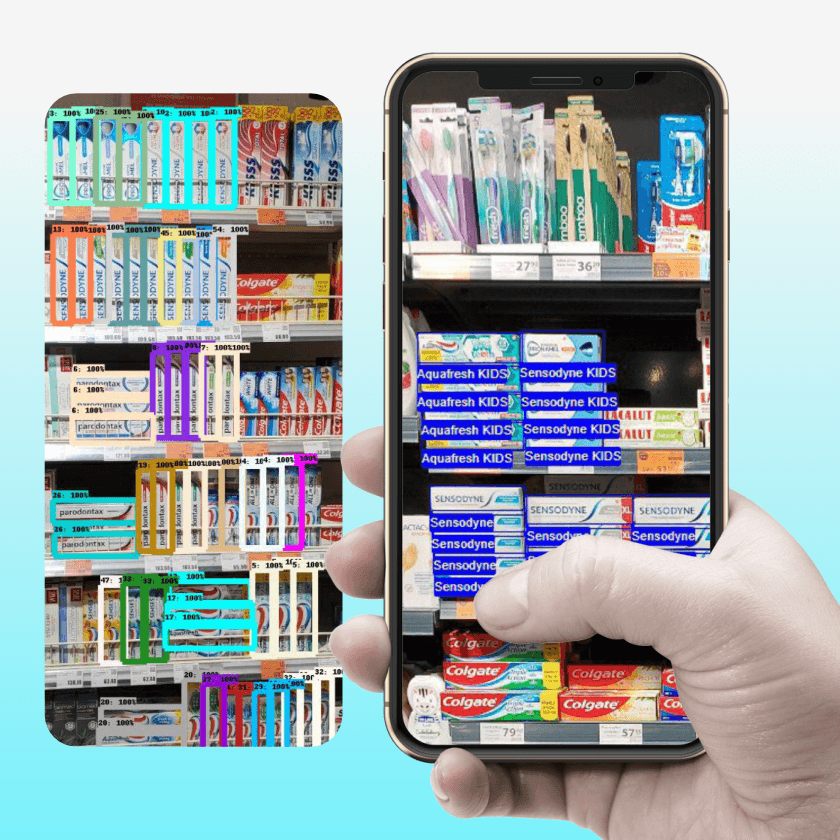
Recognition accuracy reaches 95% or higher after just two weeks of piloting. If the shelf is long or tall and doesn’t fit in one frame, the system stitches multiple images into a single picture.
Importantly, the merchandiser’s workflow doesn’t change. They still come to the store, stock products on the shelf, and take photos — except now, instead of sending images via messenger, the entire process is automated through the app. Everything else the system handles.
— How long does integrating Goods Checker with retailer systems take?
— Goods Checker integrates via API, which matters from a client convenience standpoint. If the company already has its own tool for merchandisers, we connect to it and employees continue working in their familiar environment. If there’s no such tool, merchandisers use the Goods Checker mobile app.
We use a REST API with detailed documentation, making integration straightforward and fast. While the technical team handles integration, we’re already training the neural network on the client’s SKUs, which significantly reduces the overall project launch time. Based on our experience, the time from project start to launch is two to three weeks.
— Who are your main competitors in this sector?
— The competitive landscape varies significantly from market to market — in some places there are already established players, in others we’re among the first to arrive. But regardless of the market, most such solutions target very large businesses and require lengthy implementation timelines and substantial budgets.
We always start with a trial period. Our approach to neural network training makes it possible to launch projects even for a small number of SKUs. In two weeks, a company can test the solution on their assortment and understand its value before scaling to the entire portfolio. Existing processes don’t change — the system integrates with what the client already has.
— Which retail formats is Goods Checker suited for? Does it work equally well in supermarkets, convenience stores, and hypermarkets?
— Our clients are manufacturers, distributors, and merchandising agencies. Each has its own challenge. A manufacturer or distributor wants to know how their products are represented on shelves. An agency wants to service more stores in the same amount of time and show clients transparent analytics on their work. Goods Checker solves both challenges, so the store format isn’t a fundamental factor. The system works equally well in supermarkets, convenience stores, and pharmacies.
Solution effectiveness largely depends on the number of tracked SKUs and their turnover. In a hypermarket with thousands of items, controlling the entire assortment using computer vision isn’t practical. For a manufacturer or agency tracking a key assortment, the benefits go beyond operational efficiency — sales growth from proper shelf placement typically covers the cost of Goods Checker quickly.
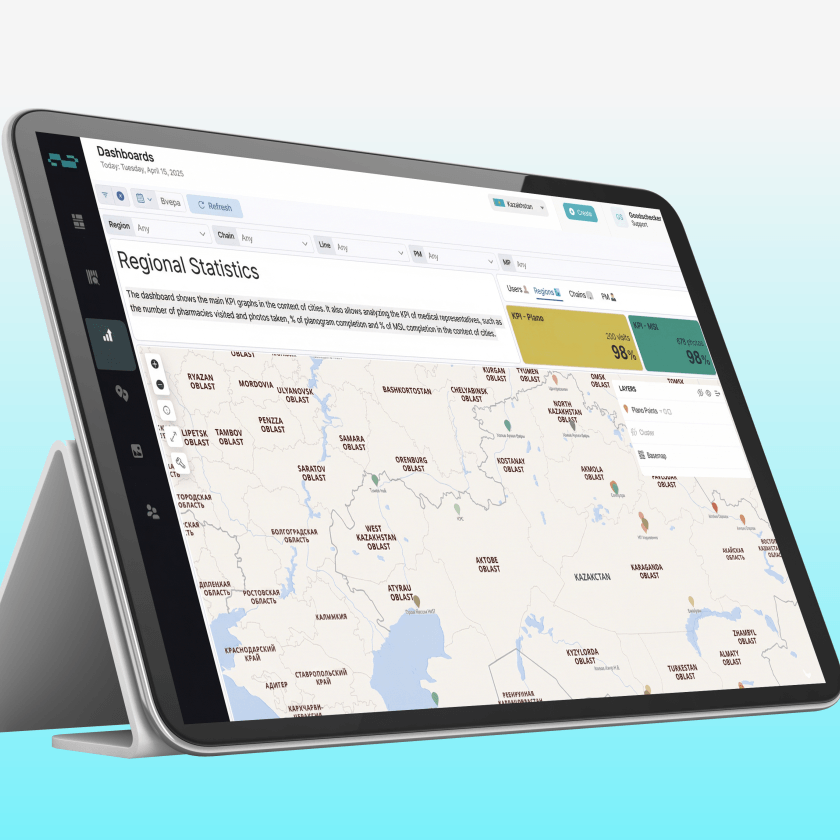
— What data and analytics does a client receive after a shelf audit? How can these insights be used for assortment or category management?
— After each merchandiser visit, the manufacturer gets a complete picture of their products: where facings are lacking, where shelf standards are violated, and where there are issues with price tags or promotional materials. Shelf share is visible separately — both their own and competitors’. This makes it possible not just to control your own display, but to track how competitor shelf presence shifts, which chains they’re strengthening positions in, and where there’s an opportunity to take their space.
Analytics can be viewed across any dimension — by chain, region, individual store, merchandiser, brand, or individual SKU. This helps quickly identify whether a problem is systemic or a one-time violation, and allows decisions to be made without unnecessary approvals. Data integrates with the client’s BI systems, so all information flows to where they’re already accustomed to viewing it. And if there’s no BI system yet, basic reports are available directly in the Goods Checker web application.
— A client not yet familiar with Goods Checker will immediately ask: “How much does it cost?” What do you say?
— Pricing depends on project scale. We offer monthly subscription billing, with cost calculated based on SKU count — not visit count or number of processed photos. This gives clients transparency and cost predictability, since the budget doesn’t fluctuate based on how actively merchandisers work. The more SKUs connected, the lower the per-unit cost.
But before discussing price, a different question is worth answering first: which SKUs generate the most revenue, and what’s currently happening with their shelf placement. If products are regularly positioned incorrectly or absent from shelves, the losses from that significantly exceed subscription costs. We recommend starting with priority items to quickly see results and assess ROI in practice.
The main upfront investment comes when we train the neural network on the client’s products. That’s exactly why we begin the cost discussion only after understanding the client’s challenge together — and only then prepare a commercial proposal, following an NDA and a review of the project configuration.
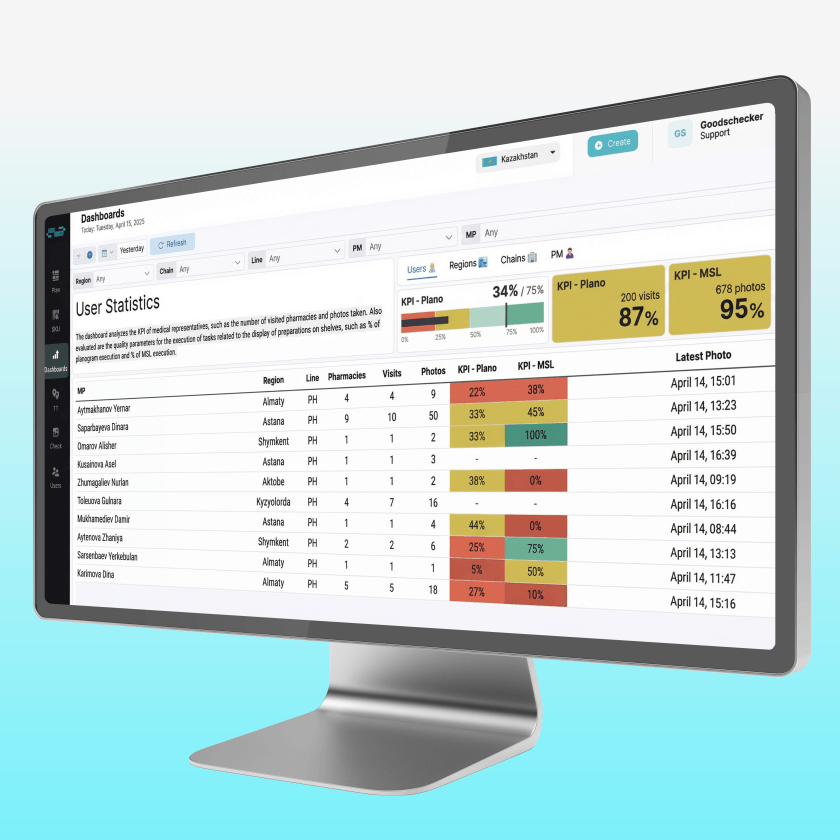
— What results have real Goods Checker implementations in Ukraine and abroad already shown? Can you share effectiveness examples with numbers?
— I’ll share examples from several projects. Ukrainian merchandising agency Lex Marketing launched a pilot in two weeks across 6 cities, 45 retail chains, and 694 stores. Merchandisers started spending 70% less time on report completion, and store audits in some locations became twice as fast. After the pilot, the project scaled more than sixfold. Today the system has been running for several years across more than 4,500 stores nationwide.
In Central Asia, pharmaceutical company Polpharma Santo uses Goods Checker to manage display compliance across more than 10,000 pharmacies. The system tracks over 140 of their own SKUs, allowing managers to monitor their brand presence — and competitor brands — immediately after each medical representative visit.
A major tobacco manufacturer from Central Europe connected Goods Checker across more than 5,000 stores, 100 merchandisers, and over 220 SKUs, including competitor products. By the end of the pilot, the share of processed photos had grown from 3% to 100%, and planogram compliance had improved from 60% to 90%. The client continues to actively use Goods Checker.
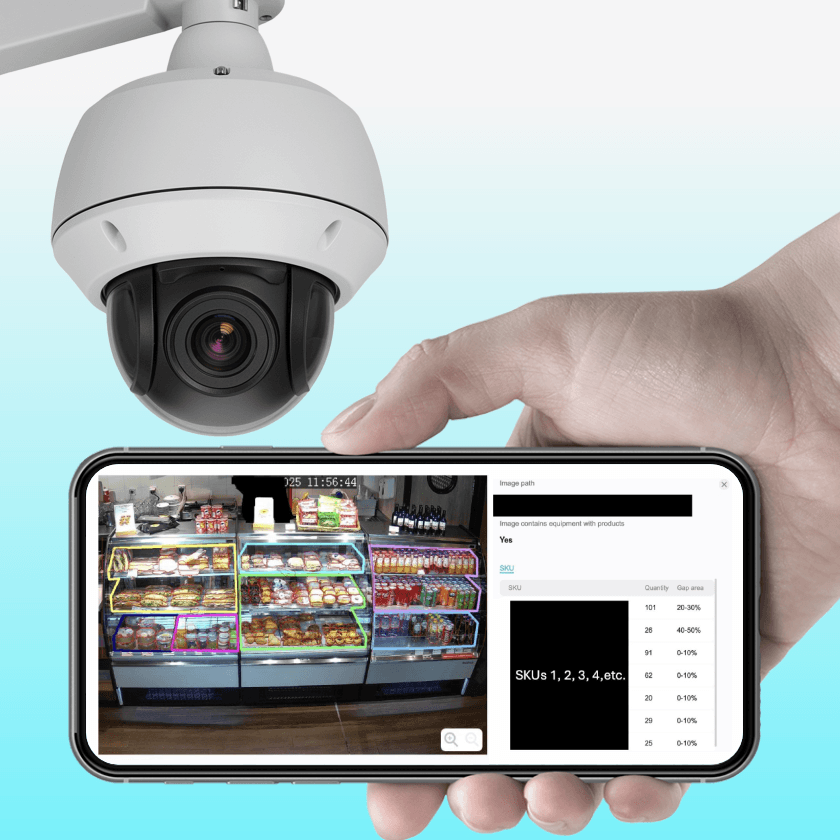
Video surveillance provider AVS Services in Spain and Portugal integrated Goods Checker with stationary cameras installed in cafes to automatically track product availability on displays. The system identifies empty spaces and sends employees notifications when products need to be restocked. As a result, shelf fullness during peak hours grew by 25%.
Many clients aren’t ready to launch a full project right away. That’s why we always start with a trial period — it costs significantly less than a full production implementation and demonstrates how the solution performs on your specific assortment and in your specific stores.
Discover more success stories
— In your opinion, how ready is the Ukrainian market for AI tools like this? How have the war and economic challenges affected demand?
— The Ukrainian market has long been ready for process automation, and recent years confirm this — demand for such solutions is steadily growing. Companies have learned to operate under uncertainty and have come to value tools that give them situational control without increasing headcount.
One of the main demand drivers has been staffing challenges. Mobilization took a significant share of the male workforce out of the labor market — people who traditionally held merchandiser and field employee positions. Finding, training, and retaining staff has become significantly harder, and remaining employees are forced to cover more stores in less time. In these conditions, tools that enable each merchandiser to work faster without sacrificing quality have become not just a convenience, but a necessity.
At the same time, Ukrainian business has long embraced digitalization. Manufacturers and agencies understand the value of data and know how to work with it. So the conversation around computer vision here isn’t starting from zero — it’s a logical next step in a process automation journey that’s already well underway.
— How do you see these solutions evolving in retail over the next 3–5 years? Can computer vision become the standard for shelf management?
— Computer vision in merchandising has already moved past the novelty stage. Over the next three to five years it will become a baseline standard for display management — much like CRM systems before it. Manufacturers and agencies that begin implementing automation now are building their processes ahead of the curve, not playing catch-up.
Full planogram compliance tracking in real time, analytics across all stores simultaneously, and data for management decisions without delays — these are no longer competitive advantages, but baseline expectations.
The next step is already visible in the market: a shift from periodic audits to continuous display monitoring through video analysis from stationary cameras.
— What other opportunities does AI open up for retail?
— AI in retail offers significant opportunities to optimize business processes and make customer interactions more personalized. Key development areas include routine task automation, demand forecasting, and creating new customer experiences. Our team has extensive experience implementing AI-powered solutions, including tools built specifically for retail needs.
- Personalized marketing and sales: AI algorithms analyze consumer behavior and generate tailored offers, increasing the effectiveness of marketing campaigns.
- Demand forecasting and inventory management: AI enables more accurate sales volume forecasting, leaner warehouse inventory, and fewer out-of-stock situations.
- Service automation: Intelligent chatbots and virtual assistants handle customer requests around the clock.
- Agentic AI: Over the next one to two years, widespread adoption of agent systems is expected — systems capable of independently executing key operational tasks.
- Pricing optimization: Dynamic price adjustment in real time based on market conditions and the competitive environment.
Artificial intelligence is becoming retail’s next evolution: from controlling shelf display to comprehensively transforming the entire business model.
IBA Ukraine demonstrates how technology moves from experiment to practical business tool. Goods Checker was built to address real retail challenges — and it’s already proving its value in numbers. Companies gain not just automation, but full shelf visibility and faster, more accurate management decisions.